A Windows update can appear to turn a smooth game into a stuttering mess overnight. Before blaming the update, it helps to identify what changed. A new graphics driver may have arrived with Windows Update, shader caches may be rebuilding, an overlay may be conflicting with the game, or a Windows component may genuinely be damaged.
This guide starts with quick checks and moves toward deeper repairs. Test the same game, location and settings after each step. If you change five things at once, you will never know which one mattered.
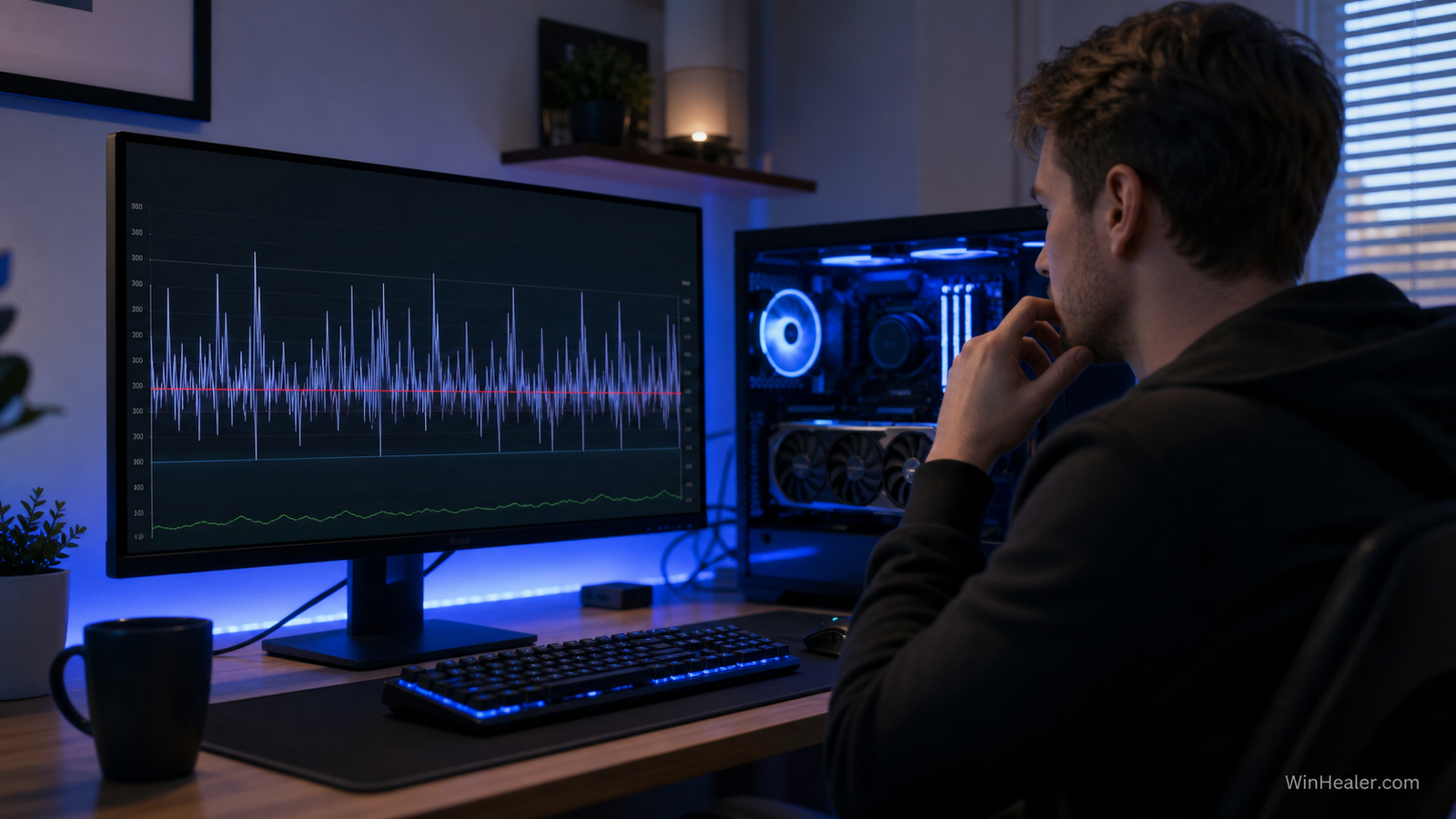
First, confirm that it is stutter—not simply low FPS
Low average frame rate feels consistently slow. Stutter is different: the game may run at 100 FPS, then briefly freeze or deliver uneven frames. If the problem lasts only during the first few minutes after a driver update, shader compilation may be responsible. Let the game finish compiling shaders where it offers that option, then revisit the same area.
Write down the Windows update date, GPU driver version, game version and when the pauses happen. A short phone video or frame-time capture can also make before-and-after comparisons much clearer.
1. Finish Windows Update and restart properly
Open Settings > Windows Update, install any pending servicing update, then use Restart rather than shutting the PC down. Some update work does not finish until a restart. Next, open Update history and note the KB number installed immediately before the issue began.
Do not uninstall anything yet. The history provides evidence that will be useful if the later checks point back to a specific update.
2. Check the graphics driver
Windows Update can replace a display driver even when you did not manually install one. Open Device Manager > Display adapters, open your GPU’s properties and record the driver version and date. Compare it with the current driver offered directly by NVIDIA, AMD or Intel for your exact GPU.
- If the driver is old, install the current stable release from the GPU manufacturer.
- If stuttering started immediately after a driver change, use Roll Back Driver when the button is available, or reinstall the previously stable vendor driver.
- Restart after the installation and retest before changing anything else.
A “clean install” can help when a normal installation is corrupted, but it should not be the automatic first step. Avoid third-party driver sites and automated driver-updater utilities.
3. Verify the game and allow shaders to rebuild
Use Steam, the Xbox app, Epic Games Launcher or the publisher’s launcher to verify the game files. If the game has a shader compilation screen, let it reach 100 percent. Deleting a shader cache can solve a corrupted cache, but the next session will often stutter while those shaders are created again. Judge the result on a second run through the same scene.
4. Test Windows graphics options per game
Go to Settings > System > Display > Graphics. On systems with integrated and discrete graphics, select the game and choose the high-performance GPU. Windows 11 also offers Optimizations for windowed games for compatible DirectX 10 and DirectX 11 titles. Microsoft says the feature changes compatible windowed and borderless games to a newer presentation model that can reduce frame latency.
Usually it is worth leaving the feature enabled. If the stutter affects only one older title, toggle it for that game, restart the game and compare. Treat Auto HDR, variable refresh rate and Hardware-accelerated GPU scheduling in the same way: change one setting, record the result, then restore it if there is no improvement.
5. Disable recording tools and overlays temporarily
Frame-rate counters, RGB utilities, browser video, hardware monitoring and overlays can all hook into a game. Temporarily close the Xbox Game Bar capture feature, Discord overlay, Steam overlay, GPU recording overlay and third-party monitoring tools. Also check Task Manager for a process suddenly using CPU, disk or memory during the pause.
If the problem disappears, re-enable the tools one by one. Keeping every overlay disabled forever is unnecessary when one specific conflict is responsible.
6. Try a clean boot to isolate background conflicts
Microsoft’s clean-boot procedure starts Windows with essential drivers and a limited set of startup software. Search for msconfig, open System Configuration, select Hide all Microsoft services, disable the remaining third-party services, then disable enabled startup items in Task Manager. Keep a record so you can restore them later.
Test the game in this clean environment. If it runs smoothly, enable services and startup apps in small groups until the stutter returns. Restore normal startup after troubleshooting; a clean boot is a diagnostic state, not a permanent performance mode.
7. Repair Windows system files
If other Windows features also freeze, fail to open or behave incorrectly, system files may be damaged. Open Terminal or Command Prompt as administrator and run DISM first:
DISM.exe /Online /Cleanup-image /RestorehealthWait for it to complete, then run:
sfc /scannowMicrosoft recommends DISM before System File Checker because DISM supplies files needed for the repair. Let both commands finish; do not close the window halfway through.
8. Uninstall the recent Windows update only as a controlled test
If the issue began immediately after a specific KB update and every earlier check failed, open Settings > Windows Update > Update history > Uninstall updates. Remove only the suspected recent update, restart and test. Some security or servicing updates cannot be removed.
This is a temporary diagnostic step, not a long-term security strategy. Record the KB number, check Microsoft’s known-issue information, and reinstall the update or its replacement when a confirmed fix becomes available.
What not to do
- Do not install registry cleaners or mysterious “FPS booster” packages.
- Do not disable Windows security services permanently.
- Do not delete random driver folders or system files.
- Do not update the BIOS merely because one game stutters unless the board vendor documents a relevant fix.
- Do not compare different game locations or settings and call the result a solution.
A sensible order that saves time
- Restart and finish pending updates.
- Retest after shader compilation completes.
- Check or roll back the graphics driver.
- Verify the game files.
- Test overlays and one Windows graphics option at a time.
- Use a clean boot.
- Run DISM and SFC if Windows itself behaves incorrectly.
- Only then test removal of the suspected update.
Final thoughts
Most post-update stuttering is resolved by completing the update, correcting a graphics-driver change, allowing shaders to rebuild or finding a background conflict. The useful habit is to measure the same scene after each single change. That turns a frustrating collection of guesses into a repeatable diagnosis.
Official references
- Microsoft: Optimizations for windowed games in Windows 11
- Microsoft: How to perform a clean boot
- Microsoft: Using System File Checker in Windows
Is the Windows update really the cause?
This guide is for stutter that began immediately after a Windows update, driver replacement or settings reset. Test the same game, save location and graphics preset before and after each change. If the problem also existed before the update—or only appears in one demanding area—the next step is our broader guide to improving 1% low FPS and diagnosing game stutter, which covers shader compilation, CPU limits, storage, overlays and frame pacing.