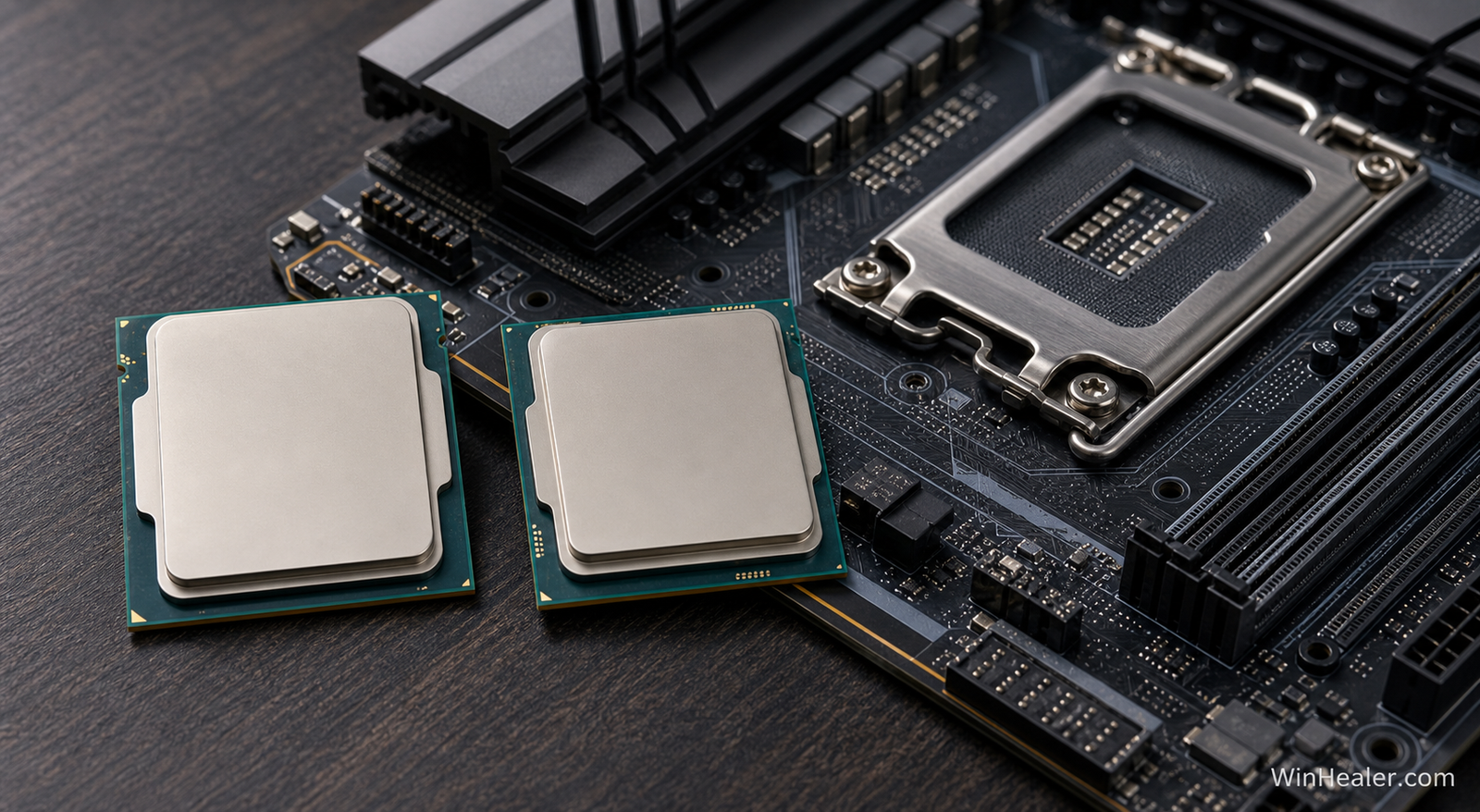
The Ryzen 7 9850X3D is easy to misunderstand. It is not a new platform or a processor with more cores than the Ryzen 7 9800X3D. Both chips are eight-core Zen 5 gaming CPUs with second-generation 3D V-Cache, 16 threads, 104 MB of total cache and a 120-watt TDP. The important difference is clock speed: AMD lists the 9850X3D with a boost clock of up to 5.6 GHz, compared with up to 5.2 GHz for the 9800X3D.
That 400 MHz uplift can make the newer chip faster, but it does not automatically make an upgrade sensible. The answer depends on the processor you already own, the games you play, your GPU, resolution and the real retail price in your country.
Ryzen 7 9850X3D vs 9800X3D specifications
| Specification | Ryzen 7 9850X3D | Ryzen 7 9800X3D |
|---|---|---|
| Architecture | Zen 5 | Zen 5 |
| Cores / threads | 8 / 16 | 8 / 16 |
| Base clock | 4.7 GHz | 4.7 GHz |
| Maximum boost | Up to 5.6 GHz | Up to 5.2 GHz |
| Total cache | 104 MB | 104 MB |
| Default TDP | 120 W | 120 W |
| Socket | AM5 | AM5 |
These are AMD’s published specifications. “Up to” boost speed is a maximum operating target, not a promise that every core will remain at that clock in every workload. Cooling, BIOS behavior, power limits, silicon quality and workload type all affect observed frequency.
Where the 9850X3D can actually be faster
Because core count and cache capacity are unchanged, the 9850X3D’s main advantage comes from its higher boost ceiling. CPU-limited games can benefit when the graphics card is waiting for the processor. This situation is most visible at 1080p, with a very fast GPU, competitive settings and a high-refresh-rate monitor.
At 1440p or 4K with high graphics settings, the GPU often becomes the limit. When that happens, replacing a 9800X3D with a 9850X3D may barely change the experience even if a low-resolution benchmark shows a measurable lead. Average FPS also tells only part of the story; frame-time consistency and 1% lows matter, but they too become difficult to separate when the GPU is fully loaded.
Game engines react differently to clock speed and cache. Simulation, strategy, esports and heavily CPU-limited titles may show a clearer difference than cinematic single-player games running with ray tracing. There is no honest universal percentage that applies to every PC.
Productivity and everyday performance
The same eight cores and 16 threads mean this is not a major workstation upgrade. A higher clock can shorten some lightly threaded tasks, but long rendering, code compilation and professional creation workloads usually benefit more from extra cores than from moving between these two closely related models.
If the PC is used mainly for gaming with occasional streaming, either chip is exceptionally capable. If rendering and production work are the priority, compare a Ryzen 9 model with more cores before paying a premium for the fastest gaming-focused Ryzen 7.
Cooling and motherboard compatibility
Both processors use socket AM5 and carry a 120 W TDP, but a good cooler is still important. AMD’s TDP figure is not a direct measurement of maximum wall power, and boost behavior responds to temperature. A capable dual-tower air cooler or suitable liquid cooler, installed with correct mounting pressure and case airflow, is a sensible match.
Owners of an existing AM5 board should check the manufacturer’s CPU support list before installing the 9850X3D. A BIOS update may be required. Update while the currently supported processor is still installed, use the exact firmware for the board revision, keep power stable and follow the board manual. Do not flash a BIOS from a similarly named model.
Should a 9800X3D owner upgrade?
For most people, no. The 9800X3D already has the same core count, architecture, cache and platform. The 9850X3D offers a higher boost ceiling rather than a different class of performance. Selling a 9800X3D, buying the replacement and spending time on the swap usually produces a poor value-per-frame result.
An upgrade becomes easier to justify only in a narrow situation: you use a top-end GPU, play CPU-bound competitive games at very high refresh rates, have confirmed the processor is the limit, and can change CPUs for a small net cost. Even then, compare trustworthy tests of the exact games you play.
Who should consider the 9850X3D?
- New premium gaming builds: choose it when its price is close enough to the 9800X3D and the rest of the build is not being compromised.
- Older AM4 owners: moving from a Ryzen 3000 or non-X3D Ryzen 5000 system can bring a substantial platform and gaming upgrade, although it also requires an AM5 board and DDR5 memory.
- Early AM5 owners: people using a Ryzen 5 or non-X3D Ryzen 7 may see a much larger improvement than a 9800X3D owner.
- High-refresh esports players: the higher ceiling is most relevant when chasing very high frame rates with a powerful GPU.
When the 9800X3D is the smarter purchase
If the 9800X3D is meaningfully cheaper, it remains the value choice for an elite gaming build. Money saved may produce a larger real-world improvement when redirected to the GPU, monitor, SSD, quieter cooler or a better power supply. At GPU-limited settings, those choices can matter more than a small CPU clock increase.
Do not compare processor price alone. Include motherboard, DDR5 memory, cooler and any BIOS-support requirements. A balanced PC consistently delivers a better experience than one flagship component surrounded by compromises.
How to judge the upgrade on your own PC
- Monitor GPU utilization in the games you actually play.
- Use the same location or repeatable built-in benchmark.
- Record average FPS, 1% lows, CPU temperature and GPU utilization.
- Test at your normal resolution and quality settings.
- Check reviews that use a GPU at least as fast as yours and disclose memory, BIOS and game versions.
If GPU utilization stays near its maximum, a faster CPU is unlikely to transform performance. If utilization repeatedly drops while one or more CPU threads are heavily loaded, the system may be CPU-limited.
Verdict
The Ryzen 7 9850X3D is the faster and more desirable option for a no-compromise new gaming build, provided its price premium is reasonable. The Ryzen 7 9800X3D remains extremely close in design and is often the better-value purchase. Existing 9800X3D owners should normally keep their CPU and wait for a more substantial architectural or core-count improvement.
For buyers coming from a much older processor, evaluate the complete platform cost and the games you play. The best CPU is not simply the one with the highest boost number; it is the one that removes the bottleneck without stealing budget from the components that matter more.