For years, “Ryzen 7 7700X3D” was the kind of model name that appeared in wish lists and mistaken product listings, not in AMD’s official catalogue. That changed in July 2026. AMD now lists a real, globally available Ryzen 7 7700X3D: an eight-core Zen 4 AM5 processor with 96MB of L3 cache and a 120W default TDP.
The obvious question is whether it makes the older Ryzen 7 7800X3D irrelevant. It does not. The two chips share the same core count, cache capacity and socket, but the 7700X3D runs at lower official clock speeds. Its appeal depends on price and on the value of extending an existing AM5 build—not on a new architecture advantage.
The official specification difference is small and important
| Specification | Ryzen 7 7700X3D | Ryzen 7 7800X3D |
|---|---|---|
| Architecture / socket | Zen 4 / AM5 | Zen 4 / AM5 |
| Cores / threads | 8 / 16 | 8 / 16 |
| Base clock | 4.0 GHz | 4.2 GHz |
| Maximum boost | Up to 4.5 GHz | Up to 5.0 GHz |
| L3 cache | 96MB | 96MB |
| Default TDP | 120W | 120W |
| Integrated graphics | 2-core AMD Radeon Graphics | 2-core AMD Radeon Graphics |
| Cooler included | No | No |
The half-gigahertz boost gap is an advertised ceiling, not a promise that every workload will sit at that frequency. Cooling, motherboard firmware, power limits and the individual processor affect real clocks. Still, the table makes the product position clear: the 7700X3D is a lower-clocked route to the same 96MB L3-cache capacity.
Why AMD would release another Zen 4 X3D chip
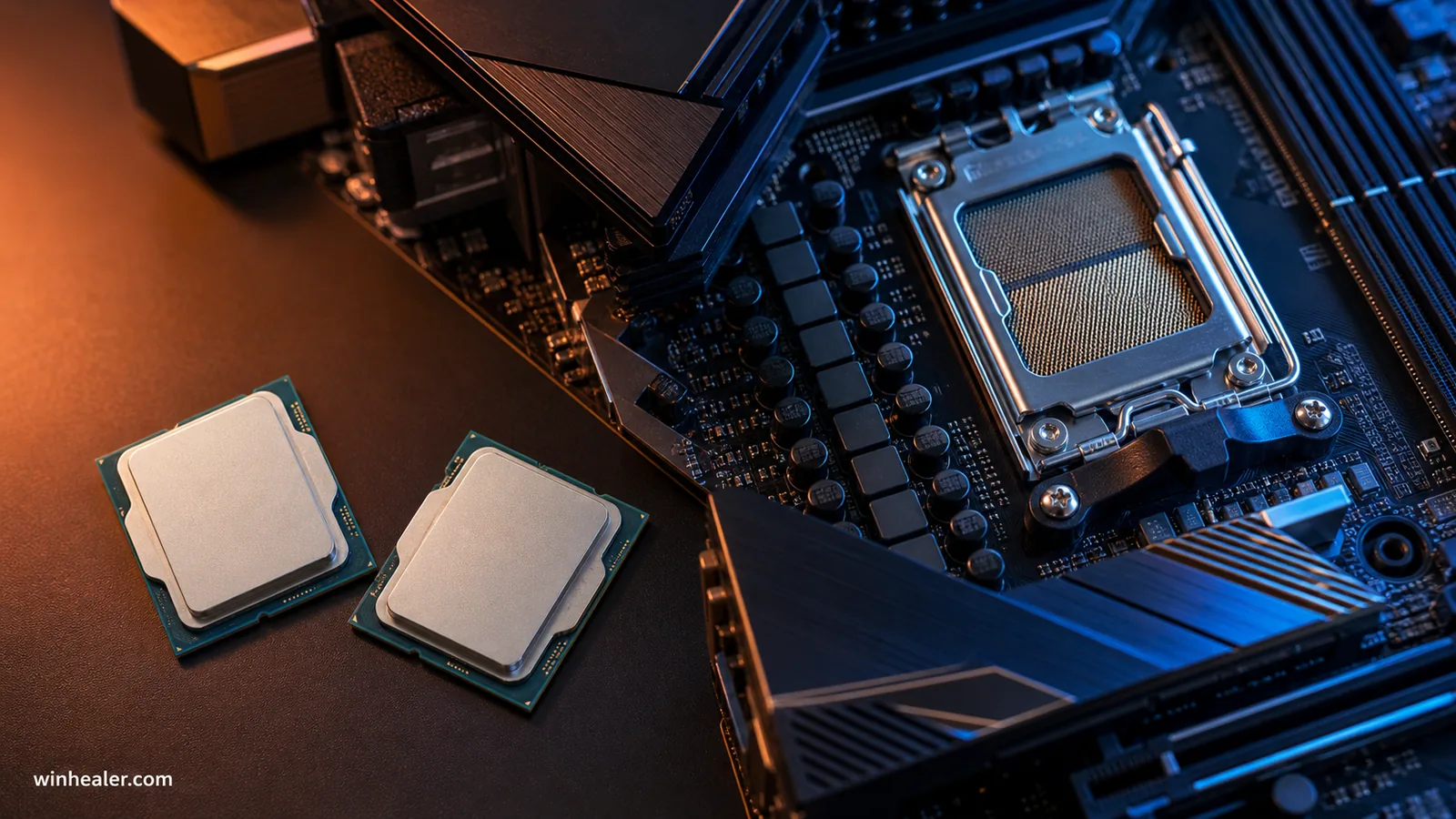
AM5 now spans several processor generations and a wide range of motherboard prices. A later Zen 4 part can give buyers another way to enter the platform or refresh an existing system without paying for a newer flagship. It also fills the space between ordinary Ryzen 7000 processors and the 7800X3D when retail inventories and regional prices do not line up neatly.
That does not automatically make it a budget product. The launch only makes sense for a buyer when the real shop price sits meaningfully below the 7800X3D and newer Ryzen 9000 X3D alternatives. Product names do not enforce street-price order.
Gaming expectations without invented benchmark numbers
Both processors place a large 3D V-Cache pool close to the CPU cores. Games that repeatedly access large working data sets can benefit from fewer trips to system memory. The lower clocks of the 7700X3D mean it should not be assumed equal to the 7800X3D in every title, even though the L3 capacity matches.
The visible difference will also depend on the rest of the PC. At 1080p with a powerful graphics card and a high-refresh target, the processor is more likely to separate the two. At demanding 4K settings, the GPU frequently becomes the limit and can hide much of the CPU gap. Simulation, strategy and competitive games may react differently from a cinematic GPU-heavy title.
Use independent reviews that test both chips with the same GPU, memory, game build and settings. AMD’s specifications describe the hardware; they do not supply a neutral purchase ranking.
Three buyer situations
1. You already own a Ryzen 5 on AM5
A drop-in upgrade can be attractive if the games you play are CPU-limited. Update the BIOS while the old processor is still installed, confirm support on the motherboard’s CPU list and record stable memory settings. After the swap, load BIOS defaults once before re-enabling EXPO or custom tuning.
Do not upgrade only because GPU utilization briefly falls below 100 percent. Check frame-time behavior, per-core load and a repeatable game scene. If the current graphics card is the limit at your chosen resolution, a CPU change may produce little visible improvement.
2. You are building a new AM5 gaming PC
Compare the complete platform price. The 7700X3D and 7800X3D both need a compatible AM5 motherboard, DDR5 memory and a separate cooler. A less expensive processor that allows a stronger GPU can produce the better gaming system, but a tiny CPU discount is not enough to justify giving up clock speed.
3. You already own a 7800X3D
The 7700X3D is not an upgrade. It has the same core count and L3 cache with lower official clocks. Keep the 7800X3D unless the system has an unrelated problem. New product availability does not turn working hardware into a bottleneck.
Motherboard and BIOS compatibility
AMD lists A620, B650, B650E, X670, X670E, B840, B850, X870 and X870E chipsets among the supported families for the 7700X3D. A chipset name alone is not enough. The exact board model needs a BIOS version that contains support for this processor.
Visit the motherboard manufacturer’s support page, open its CPU-support list and find the 7700X3D. Note the minimum BIOS. Follow the vendor’s documented update process and do not interrupt power during firmware flashing. If a shop is assembling the PC, ask it to confirm the installed BIOS before shipping.
Cooling and power
Both chips have a 120W default TDP and neither includes a boxed cooler. AMD recommends liquid cooling for optimal 7700X3D performance, but cooler choice should also consider case airflow, ambient temperature, noise target and sustained workload. A well-installed, capable cooler matters more than decorative size.
Use stock operation first. X3D processors have specific voltage and thermal behavior, so copied manual-overclock settings are a poor starting point. Precision Boost Overdrive and Curve Optimizer support are listed by AMD, but every change should be tested for crashes, calculation errors and game stability.
Memory advice
Both processors use DDR5 and support AMD EXPO. A two-module kit is easier on the memory controller than filling all four slots at high speed. The advertised kit profile is an overclock, not a guarantee for every CPU, motherboard and BIOS combination.
Start with the board’s qualified-memory list, update the BIOS and run a memory test after enabling EXPO. Large cache can reduce sensitivity to memory performance in some games, but unstable RAM is never an acceptable trade for a small benchmark gain.
The decision rule
- Buy the 7700X3D when it is substantially cheaper, the motherboard supports it and the saved money improves the GPU, monitor or storage.
- Buy the 7800X3D when its price is close and you want the higher official clocks from this Zen 4 pair.
- Compare newer X3D chips when building from scratch; an old-generation bargain is only a bargain beside current alternatives.
- Keep your existing 7800X3D; the 7700X3D is a lower-positioned option, not a replacement upgrade.
Final verdict
The Ryzen 7 7700X3D is real, official and globally listed by AMD in 2026. It brings the familiar eight-core Zen 4 and 96MB L3-cache formula back at lower clock speeds than the 7800X3D. That makes it a value decision rather than a technology leap.
Ignore the excitement of a newly filled product gap and compare actual prices. With a meaningful discount, the 7700X3D can be a smart AM5 gaming chip. With only a small difference, the 7800X3D’s higher clocks—or a fairly priced newer X3D processor—deserve the money first.