Quick answer: RAM performance is the result of bandwidth, latency, the CPU’s memory controller and the workload—not one impressive number on a box. DDR5-6000 CL30 has a first-word CAS delay of about 10 nanoseconds and is a strong, practical target on many modern gaming systems. DDR5-4800 CL40 is slower on paper at roughly 16.7ns, but it is a conservative baseline that is easier to run. DDR5-9000 can deliver enormous bandwidth, yet it is an overclocking-class setting that needs a suitable CPU, motherboard, firmware and memory kit. It is not automatically faster in every game.
Memory specifications have developed their own dialect. Shops say “6000MHz RAM,” monitoring programs may display 3000MHz, the box says 6000MT/s, and the BIOS adds MCLK, UCLK, FCLK or Gear Mode. All of them can describe the same system from different angles. This guide translates those numbers into information you can actually use.
First correction: 6000 “MHz” DDR5 is normally 6000 MT/s
DDR means double data rate. The memory transfers data on both edges of each clock cycle. A kit sold as DDR5-6000 therefore operates with a physical memory clock around 3000MHz while providing 6000 million transfers per second—6000MT/s.
Calling it “6000MHz” has become common retail shorthand, but it is not technically precise. Your monitoring software is not cutting your RAM speed in half when it reports about 3000MHz. Multiply that clock by two to get the effective DDR data rate.
| Advertised data rate | Approximate DRAM clock | Peak bandwidth per 64-bit channel |
|---|---|---|
| DDR5-4800 | 2400MHz | 38.4GB/s |
| DDR5-6000 | 3000MHz | 48.0GB/s |
| DDR5-9000 | 4500MHz | 72.0GB/s |
The bandwidth figures are theoretical: data rate × 8 bytes. A dual-channel desktop platform can theoretically double them, but real applications do not achieve perfect efficiency. DDR5 DIMMs also divide their 64-bit data path into two independent 32-bit subchannels. That improves access efficiency; it does not turn one ordinary desktop DIMM into a complete dual-channel kit.
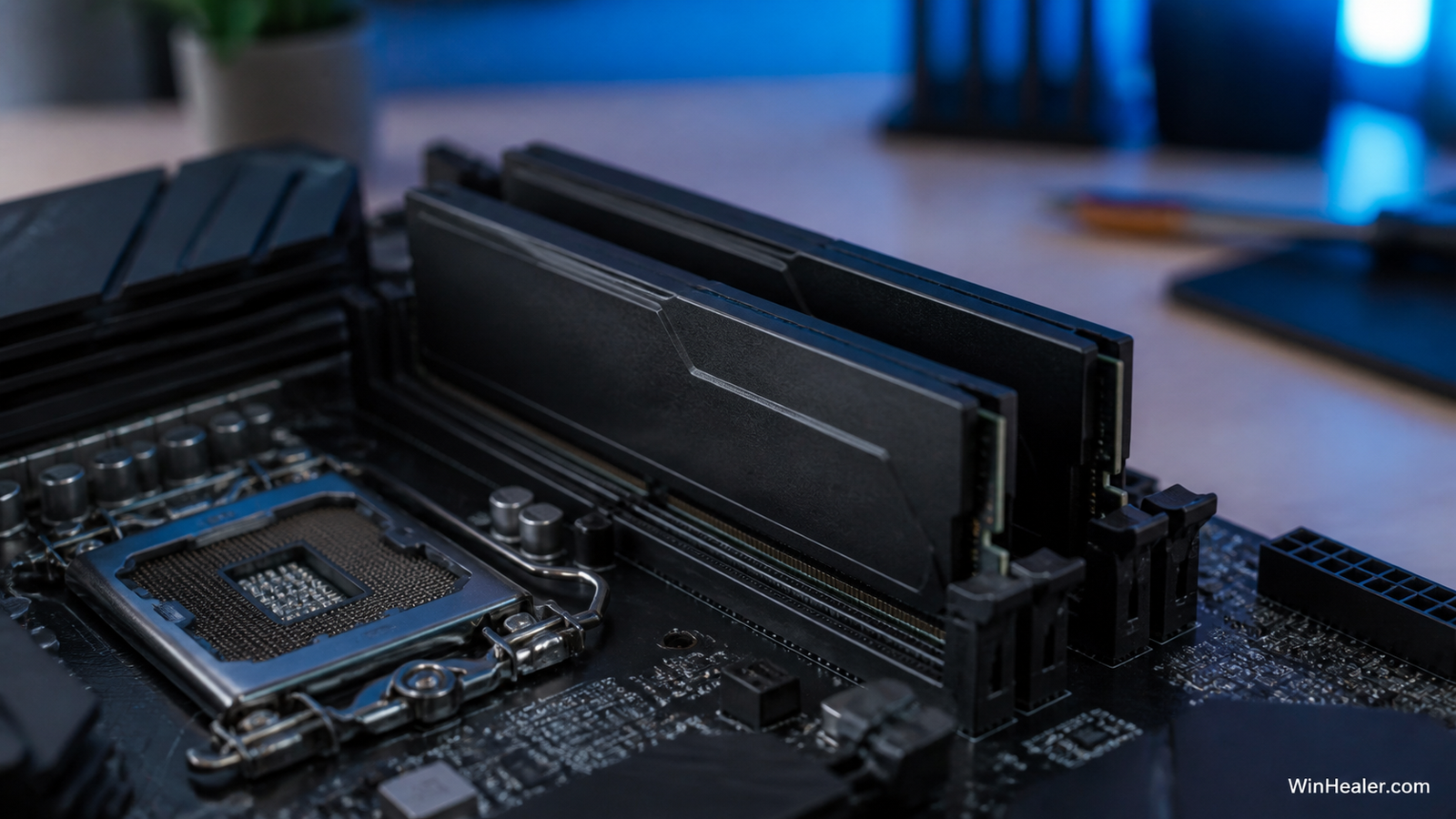
What RAM latency actually means
Latency is delay. Bandwidth describes how much data can move after a transfer is underway; latency describes how long the system waits before useful data begins arriving. A wide motorway can carry many cars, but it does not guarantee that the first car reaches you quickly.
The familiar CL value is CAS latency: the number of memory-clock cycles between a column-read command and the beginning of the requested data. CL30 is fewer cycles than CL40, but cycles get shorter as the clock rises. That is why CL alone cannot compare kits running at different data rates.
Calculate CAS latency in nanoseconds
Use this practical formula:
CAS latency in ns = CL × 2000 ÷ data rate in MT/s
| Example kit | Calculation | First-word CAS latency |
|---|---|---|
| DDR5-4800 CL40 | 40 × 2000 ÷ 4800 | 16.67ns |
| DDR5-6000 CL30 | 30 × 2000 ÷ 6000 | 10.00ns |
| DDR5-6000 CL36 | 36 × 2000 ÷ 6000 | 12.00ns |
| DDR5-9000 CL42 | 42 × 2000 ÷ 9000 | 9.33ns |
| DDR5-9000 CL48 | 48 × 2000 ÷ 9000 | 10.67ns |
This calculation is useful, but it is not the latency of the whole PC. The CPU cache hierarchy, memory controller, command rate, secondary timings, operating mode and memory-access pattern all add delay. Crucial’s comparison of standard DDR5-4800 CL40 and DDR4-3200 CL22, for example, shows similar system-level latency even though their calculated CAS figures differ. A synthetic benchmark’s 60–90ns result is therefore not contradicting a 10ns CAS calculation; it is measuring a longer journey.
What 30-38-38-96 and similar timings mean
A memory kit may list four primary timings, such as 30-38-38-96. They are measured in clock cycles:
- tCL: CAS latency—the delay from a read command to data output when the row is ready.
- tRCD: row-to-column delay—the wait between activating a row and accessing a column.
- tRP: row precharge—the time needed to close one row before another can open.
- tRAS: row active time—the minimum period a row must remain active to finish its work safely.
Workloads with many row changes care about more than CL. Two “6000 CL30” kits can behave differently because their tRCD, tRP, subtimings, ranks and controller settings are different. Primary timings make a convenient headline; they are not a full performance fingerprint.
Secondary and tertiary timings
Settings such as tRFC, tREFI, tRRD, tFAW and tWR govern refreshes and other internal operations. Skilled tuners can find performance here, but aggressive values can create rare errors that a five-minute benchmark misses. A PC that completes one benchmark but corrupts a compressed archive next week is not stable.
DDR5-4800: the safe baseline
DDR5-4800 was an early standard data rate and remains a useful compatibility baseline. A motherboard normally reads safe JEDEC information from the module’s SPD and boots at a supported standard configuration before an XMP or EXPO profile is enabled.
Choose a conservative speed when reliability, broad compatibility or capacity matters more than the last few percent of performance. Four DIMMs, very large modules and server-style workloads place a heavier electrical load on the memory controller. Dropping the data rate can be the correct engineering decision, not a failure.
For a gaming PC, 4800 CL40 leaves bandwidth and latency performance on the table compared with a well-tuned 6000 kit. The difference will be most visible when the game is CPU-limited. At 4K with the graphics card fully occupied, the frame-rate difference may be small.
DDR5-6000: the balanced performance class
DDR5-6000 is popular because it offers a meaningful bandwidth gain without entering the most extreme frequency range. A good CL30 kit combines 48GB/s of theoretical bandwidth per 64-bit channel with a calculated 10ns CAS delay.
AMD’s current EXPO page uses DDR5-6000 CL28, CL30 and CL36 in its 2026 latency testing on a Ryzen 7 9700X/X870E system. That does not guarantee that every AM5 CPU and motherboard will run every 6000 kit, but it confirms that 6000 remains a relevant performance class. AMD also describes EXPO as memory overclocking, even when it is enabled with one BIOS option.
On Intel systems, XMP performs a similar job by loading validated frequency, timing and voltage values stored on the module. Intel calls XMP an overclocking technology too. A profile validated by the memory manufacturer improves convenience; it cannot guarantee the quality of your individual CPU memory controller or motherboard layout.
DDR5-9000: huge bandwidth, serious requirements
DDR5-9000 provides 50% more theoretical bandwidth than DDR5-6000. That sounds decisive, but reaching the number can require a recent platform, an excellent two-slot or carefully designed four-slot motherboard, the correct single-rank DIMMs or CUDIMMs, mature BIOS support and a strong memory-controller sample.
At these speeds the system may change the ratio between the controller and memory clock. The resulting controller penalty can consume part of the latency improvement. Some workloads love bandwidth; others care more about response time. Consequently, a stable 9000 kit can win compression, integrated-graphics or memory-bandwidth tests while producing a smaller gain—or even losing to a better-balanced configuration—in a particular game.
Intel’s official 200S Boost guidance supports XMP profiles up to DDR5-8000 on select Core Ultra 200S/Z890 combinations. Kits marketed at 9000 and beyond sit further into board- and silicon-dependent overclocking territory. Motherboard makers have demonstrated speeds above 10,000MT/s, but a record or qualified-memory-list entry is not a universal everyday guarantee.
Memory clocks: MCLK, UCLK, FCLK and Intel Gear Mode
MCLK: the memory clock
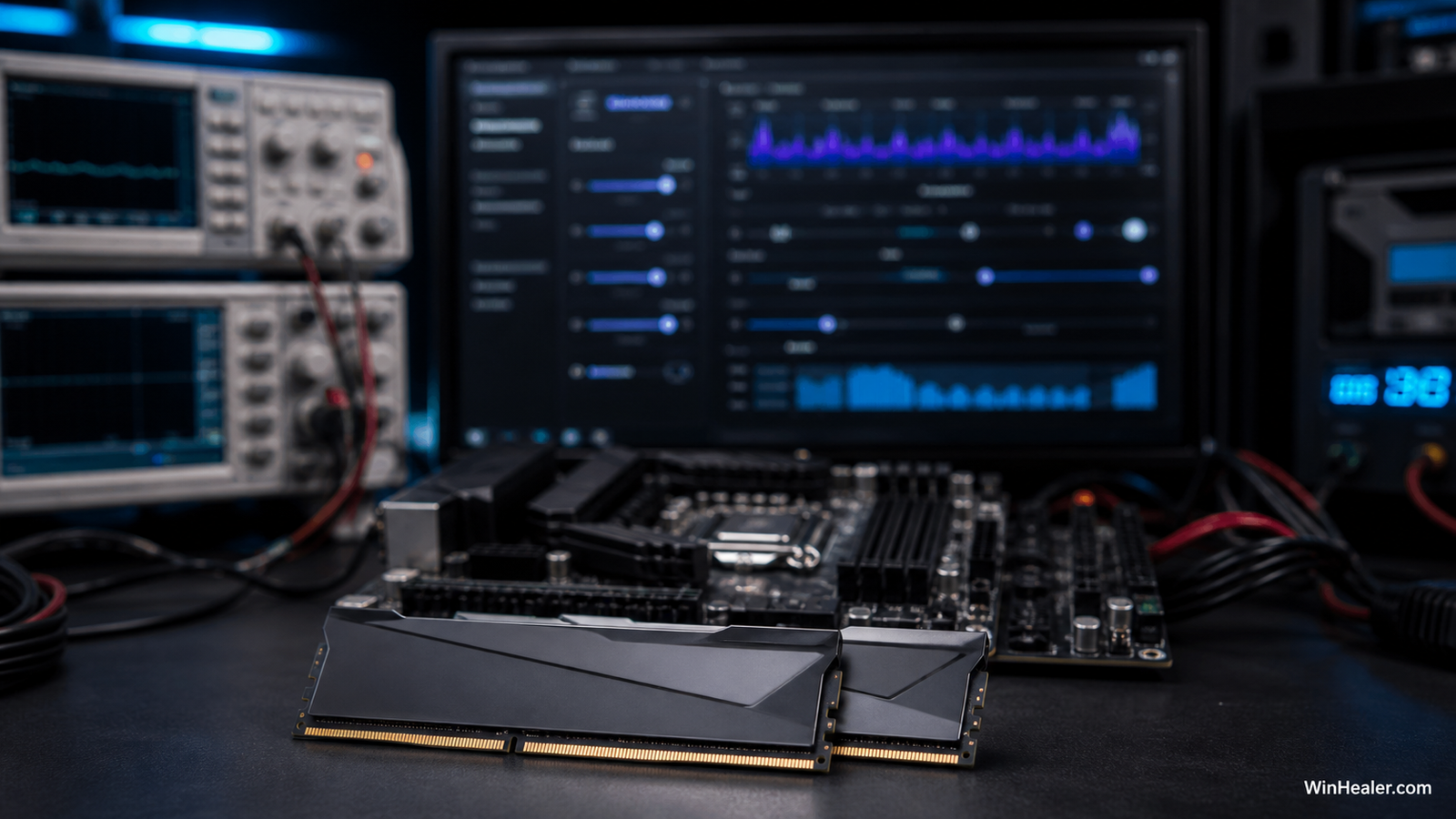
MCLK is the real DRAM clock. DDR5-6000 normally means an MCLK around 3000MHz. Some BIOS and tuning tools offer either MHz or MT/s units, so read the label before assuming a value is wrong.
UCLK: the memory-controller clock
UCLK describes the clock of the CPU’s integrated memory controller on supported AMD platforms. A 1:1 relationship can reduce controller latency, while a divided mode can permit a higher memory data rate. The best result is platform- and workload-specific; forcing a ratio that the controller cannot sustain is worse than using a stable automatic mode.
FCLK: the fabric clock
FCLK is associated with AMD’s internal fabric, not the DDR transfer rate itself. Older Ryzen tuning advice often insisted on matching fabric and memory ratios. That advice should not be copied blindly to DDR5-era AM5 systems. AMD’s Ryzen Master documentation exposes Memory Clock, Fabric Clock and U Clock Mode as separate controls because they are distinct domains.
Intel Gear modes
Intel platforms can run the memory controller at a divided ratio relative to the DRAM clock. Lower-ratio controller operation makes very high memory frequencies possible, but adds controller cycles. The winning configuration is the one with the best measured bandwidth/latency balance and full stability—not simply the highest POST screen number.
Why two modules often clock higher than four
Every additional DIMM increases electrical loading and makes signal integrity more difficult. Intel’s own overclocking guide notes that reducing four modules to two can improve attainable memory speed. This is also why the CPU specification table may show lower supported data rates with two DIMMs per channel or certain rank combinations.
For a new mainstream gaming build, buy the capacity you need as a matched two-module kit and install it in the motherboard manual’s preferred slots—commonly A2 and B2. Do not buy four sticks for appearance and assume the advertised XMP or EXPO speed will remain effortless.
Capacity, ranks and CUDIMMs
Capacity comes first. A 16GB system that is paging to storage will not be rescued by extreme frequency; 32GB is a comfortable target for many current gaming and general-purpose builds, while heavy creation and local AI workloads can justify more.
Rank describes an independently addressable group of memory chips, not the number of modules or DDR5’s internal subchannels. More ranks can improve bank-level parallelism but also increase controller load. CUDIMMs add a client clock driver to improve clock-signal integrity at high DDR5 data rates. They help newer platforms pursue very high speeds, but require explicit platform and motherboard support.
How to choose between 4800, 6000 and 9000
- Choose DDR5-4800/5200-class settings for maximum compatibility, large four-DIMM configurations, troubleshooting or systems whose CPU officially supports a conservative speed.
- Choose DDR5-6000 CL30-class memory for a strong balance of latency, bandwidth, availability and setup difficulty on many modern gaming PCs—after checking the board’s memory list.
- Choose DDR5-8000 to 9000+ when the platform is built for high-frequency memory, you enjoy tuning, and your workloads benefit from bandwidth. Treat the advertised profile as an overclock, not a contractual promise.
A safe setup and stability checklist
- Update the motherboard BIOS before tuning a new DDR5 kit.
- Check CPU memory support, motherboard QVL and the kit vendor’s compatibility list.
- Use the recommended slots and begin with only the matched kit.
- Boot at defaults once, then enable one XMP or EXPO profile.
- Allow memory training to finish; early DDR5 boots can take longer.
- Test memory thoroughly, then test CPU-heavy games and your real applications.
- Watch for WHEA errors, application crashes, file corruption and sleep/resume failures—not only blue screens.
- If unstable, update firmware, reduce data rate one step or return to defaults before adding voltage.
Avoid copying voltage values from a stranger’s screenshot. Safe limits vary with the memory IC, CPU generation, motherboard and cooling. Both AMD and Intel warn that operating memory beyond published specifications is overclocking and can affect warranty or reliability.
Final verdict
DDR5-6000 CL30 is easy to recommend as a balanced category, but there is no universal “best RAM speed.” DDR5-4800 prioritizes compatibility; 6000 balances bandwidth and response time; 9000 pursues maximum bandwidth at the cost of platform demands and tuning complexity. Compare true latency, full timings, capacity, module count and controller mode—then value stability above a screenshot.
If memory prices are also influencing your buying decision, read our related analysis: RAM Prices Are Rising Fast: How Phones and Graphics Cards Will Change in 2026.
Is your DDR5 still running at 4800 MT/s?
Choosing a faster kit and actually running it at its rated profile are two different jobs. If Windows or your BIOS still reports 4800 MT/s after installation, do not start changing voltages at random. Use our step-by-step DDR5 XMP and EXPO troubleshooting guide to check DIMM placement, profile selection, memory training, BIOS compatibility and stability in a safe order.
Sources and methodology
This guide was reviewed on August 12, 2026 using AMD’s EXPO documentation and 2026 latency testing notes, the AMD Ryzen Master memory-clock documentation, Intel’s XMP documentation, Intel’s 200S Boost guidance, Kingston’s timing and true-latency explanation, and Crucial’s DDR5 latency overview. Maximum stable memory speed always depends on the exact CPU, board, BIOS, DIMM population and kit.