An application opens and immediately closes. A game crashes halfway through loading. Or Windows displays, “The application was unable to start correctly (0xc0000005).” The message is frustrating because it does not identify one specific cause.
The good news is that you usually do not need to reinstall Windows. The most useful first question is simpler: does the error affect one program, or are several unrelated programs crashing? That answer determines where troubleshooting should begin.
What does error 0xc0000005 mean?
Microsoft defines 0xC0000005 as an access-violation exception. In plain English, a program tried to read, write, or execute an invalid memory address, so Windows stopped the process.
That describes what happened, but not why. The underlying problem could be a bug or damaged file in the application, an incompatible add-in, interference from another program, or a driver problem. Corrupted Windows components and unstable RAM are also possible, but they should not be assumed from the code alone.
Error 0xc0000005 does not automatically mean that your RAM is defective or that the computer has a virus.
Start with a few basic checks
Save any open work, restart the PC, and try the program again. Note the exact time of the crash and what you were doing when it happened. Also consider what changed recently: an application update, new plug-in, graphics driver, Windows update, or hardware change can provide an important clue.
Update the affected application from its built-in updater or its publisher’s official website. Then open Settings > Windows Update, select Check for updates, install the regular updates offered for your device, and restart.
Avoid downloading replacement DLL files from third-party websites. Do not use registry cleaners or disable Data Execution Prevention to make the error disappear. DEP is a Windows memory-protection feature; an incompatible application should be updated or repaired instead.
If only one application shows the error
A crash limited to one program normally points toward that application or something loaded with it.
1. Repair, reset, or reinstall the app
Open Settings > Apps > Installed apps, find the affected program, select its three-dot menu, and look for Advanced options. Choose Repair first if it is available. If Repair does not work, consider Reset, but back up application data and settings beforehand because Reset may remove them.
Not every desktop program provides these buttons. In that case, use the program’s own repair option, uninstall it, restart Windows, and download a fresh installer from the official publisher. For a game, first use the launcher’s file-verification or repair feature if it offers one.
Temporarily remove or disable add-ins, mods, overlays, capture tools, or tuning utilities that interact with the crashing program. Change one thing at a time so you know what actually fixes the problem.
2. Check the matching crash in Event Viewer
Event Viewer can confirm which executable and module were involved:
- Press Windows key + R, enter
eventvwr, and press Enter. - Open Windows Logs > Application.
- Look for an Error at the exact crash time with the source Application Error and usually Event ID 1000.
- Record the faulting application name, faulting module name, and exception code.
If the module belongs to a plug-in or other third-party component, update or remove that component. If it names a Windows DLL such as ntdll.dll, do not immediately replace the DLL. The module shown at the crash point is not necessarily the component that corrupted memory earlier. The complete event details are most useful when sent to the application publisher.
3. Test with a clean boot
A clean boot starts Windows with essential services while third-party startup software is disabled.
Search for msconfig and open System Configuration. On the Services tab, select Hide all Microsoft services before choosing Disable all. Then open Task Manager from the Startup tab and disable the enabled startup items, keeping a note of every change. Restart and test the app.
If the error disappears, re-enable the disabled services and startup items in groups until the conflict returns. Microsoft recommends testing half at a time because it finds the culprit faster. When finished, return System Configuration to Normal startup. Some features may be temporarily unavailable during a clean boot.
If several unrelated applications crash
When multiple programs report 0xc0000005, or Windows itself is freezing, check shared system components before repeatedly reinstalling individual apps.
Repair Windows components with DISM and SFC
Open Command Prompt as administrator and run:
DISM.exe /Online /Cleanup-image /RestorehealthWait for it to complete, then run:
sfc /scannowMicrosoft recommends running DISM before System File Checker because DISM repairs the Windows component source that SFC uses. Allow SFC to reach 100 percent, restart the computer, and test again. If SFC reports no integrity violations, repeatedly running it is unlikely to help.
Test the memory when the symptoms justify it
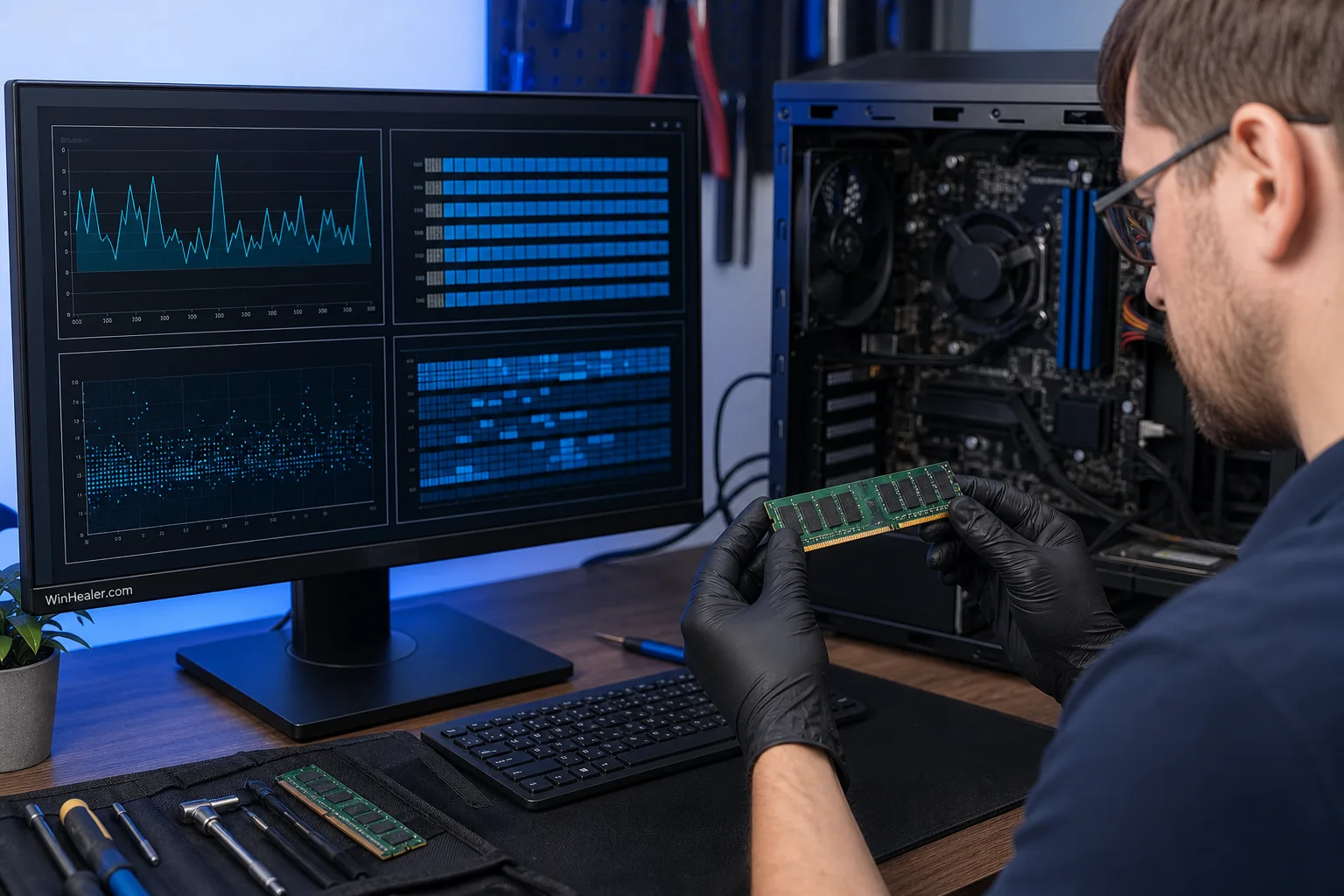
A memory test is reasonable when unrelated programs crash, the PC also freezes or restarts unexpectedly, or the problem began after RAM was installed or memory settings were changed.
Save your work, press Windows key + R, enter mdsched, and select Restart now and check for problems. Windows will reboot and run Windows Memory Diagnostic. After signing in again, Windows may display the result in a notification. You can also open Event Viewer > Windows Logs > System and search for MemoryDiagnostics-Results.
If the test reports memory errors, stop treating the issue as an application problem and contact the PC or memory manufacturer. A clean result reduces the likelihood of a RAM fault, although intermittent hardware problems may still require professional testing.
Be careful with drivers and recent updates
Microsoft recommends obtaining most drivers through Windows Update. If the crash involves games, video editing, or other GPU-heavy software, check for a suitable graphics driver through Windows Update or the GPU or PC manufacturer’s official support page. Avoid driver-download websites and “update every driver” utilities.
If 0xc0000005 started immediately after one specific driver update, open Device Manager, open that device’s properties, select the Driver tab, and use Roll Back Driver when available. Target the change connected to the timing; do not randomly downgrade several drivers.
For a system-wide problem that clearly began after a program or driver installation, System Restore can return system files, settings, and installed programs to an earlier restore point without deleting personal documents. Use Scan for affected programs before confirming the restore.
Do you need a crash dump?
Usually not. Event Viewer details, the exact reproduction steps, and a clean-boot result are enough for initial support.
Windows Error Reporting can be configured to collect per-application user-mode dumps, but that requires administrator-level registry changes. Dump files can be large and may contain information held in the application’s memory. Enable dump collection only when Microsoft Support or the application publisher requests it, follow their exact per-app instructions, remove the setting afterward, and share the file securely.
Frequently asked questions
Is 0xc0000005 a virus?
Not by itself. It is a general access-violation code used when a process performs an invalid memory operation. If you also notice unknown programs, security warnings, or other suspicious behavior, run a scan with Windows Security, but the error code alone is not evidence of malware.
Can faulty RAM cause the error?
Yes, but RAM is only one possibility. Test it later when multiple unrelated apps crash or other stability symptoms are present. A single-app failure is more likely to be solved by updating, repairing, or cleanly reinstalling that app.
Should I disable DEP?
No. Data Execution Prevention helps block code from running in protected memory areas. Disabling a security feature can hide a compatibility problem without fixing the defective application or component.
Should I reset Windows 11?
A Windows reset is a last resort for a persistent system-wide problem, not a sensible first response to one crashing app. Back up important files and obtain the BitLocker recovery key before using any major Windows recovery option.
Official Microsoft sources
- Microsoft Learn: Access Violation C0000005
- Microsoft Learn: Data Execution Prevention
- Microsoft Support: Fix problems that block programs from being installed or removed
- Microsoft Learn: Troubleshoot application or service crashes
- Microsoft Support: How to perform a clean boot in Windows
- Microsoft Support: Using System File Checker in Windows
- Microsoft Support: Windows Memory Diagnostic instructions
- Microsoft Support: Update drivers through Device Manager
- Microsoft Support: System Restore
- Microsoft Learn: Collecting user-mode dumps
Fact-checked against official Microsoft material on August 1, 2026.