Research note: Specifications and product status were checked against official NVIDIA and AMD sources on August 1, 2026. Launch prices below are historical reference points, not current street prices. Manufacturer specifications and claims are not independent benchmark results.
RTX 5070 vs RX 9070 XT: the quick answer
For a 1440p gaming PC, the Radeon RX 9070 XT is the stronger on-paper choice when prices are close. It has 16GB of VRAM—4GB more than the GeForce RTX 5070—and a larger 304W power envelope. That is attractive for high-resolution textures and a card you plan to keep.
Choose the RTX 5070 if you need CUDA, prefer DLSS in your games, or want its lower 650W PSU recommendation. Its Founders Edition is also a compact two-slot card.
This is not an FPS verdict. The manufacturers publish no neutral test of these exact cards, and this article uses primary sources only. Check independent native, ray-tracing and 1% low results for your games before buying.
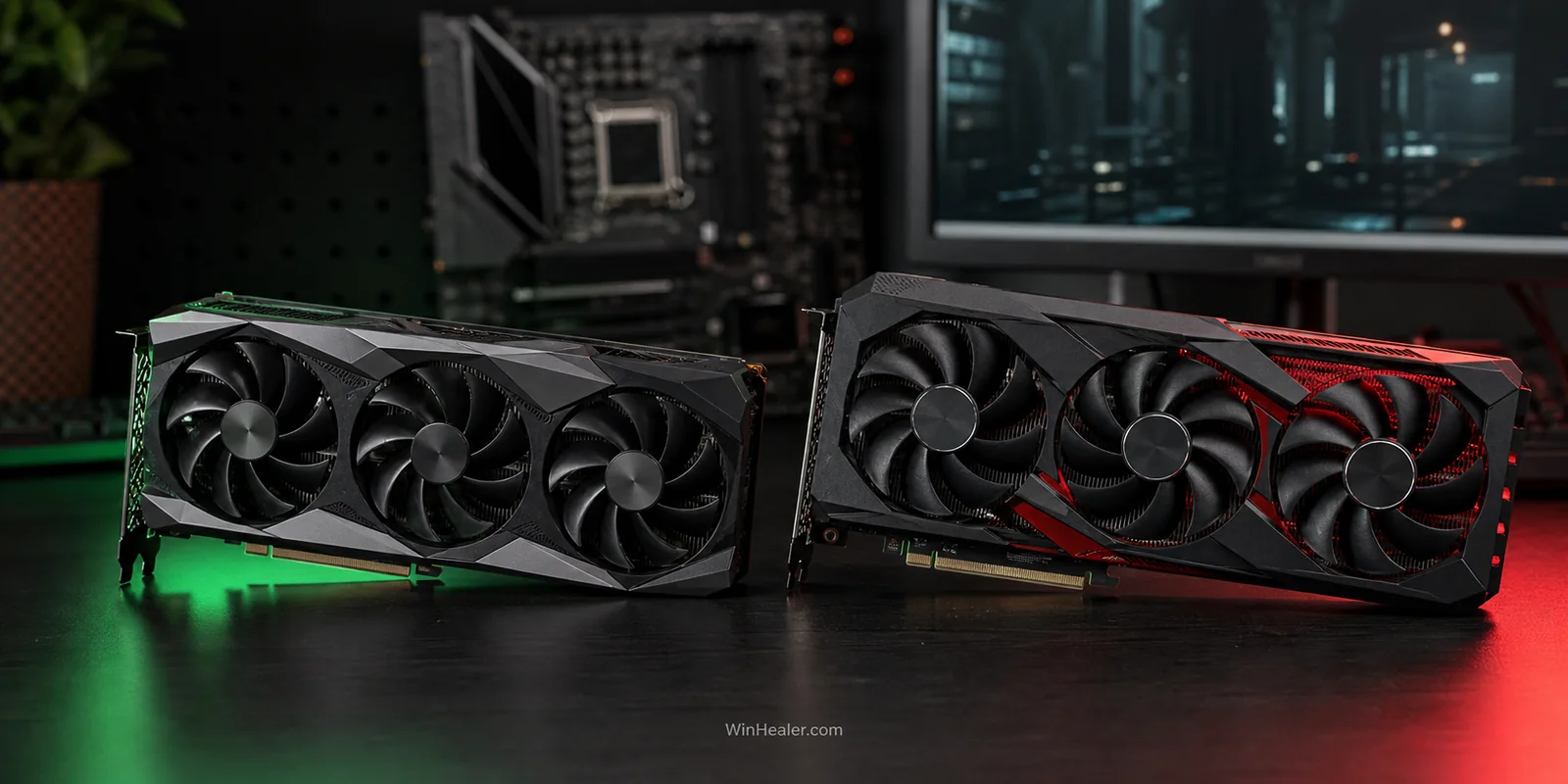
Official specifications side by side
| Specification | GeForce RTX 5070 | Radeon RX 9070 XT |
|---|---|---|
| Architecture | NVIDIA Blackwell | AMD RDNA 4 |
| Processing resources | 6,144 CUDA cores | 64 compute units / 4,096 stream processors |
| Ray-tracing hardware | 4th-generation RT cores; 94 RT TFLOPS listed | 64 ray accelerators |
| AI hardware | 5th-generation Tensor cores; 988 AI TOPS listed | 128 AI accelerators |
| Official clocks | 2.33GHz base; 2.51GHz boost | 2.40GHz game; up to 2.97GHz boost |
| Memory | 12GB GDDR7 | 16GB GDDR6 |
| Memory interface | 192-bit | 256-bit |
| Official memory bandwidth | 672GB/s | Up to 640GB/s |
| Current feature family | DLSS 4.5 on NVIDIA’s current product page | AMD FSR “Redstone” listed on AMD’s current product page |
| AV1 encode/decode | Yes / yes; one 9th-gen NVENC | Yes / yes |
| Display outputs | 3x DisplayPort 2.1b, 1x HDMI 2.1b | DisplayPort 2.1a, HDMI 2.1b; layout varies by card |
| Board/graphics power | 250W total graphics power | 304W typical board power |
| Recommended system PSU | 650W | 750W |
| Listed power input | Two 8-pin cables via adapter, or a 360W+ PCIe Gen 5 cable | 2x 8-pin |
| Launch price | $549 starting price | $599 SEP |
CUDA cores, stream processors and AI figures are architecture-specific, not one-for-one performance units. Specifications describe the cards; they do not predict a game’s FPS.
1440p raster gaming and VRAM
The RX 9070 XT’s clearest advantage is capacity. Twelve gigabytes remains usable at 1440p, but 16GB leaves more room for ultra textures, ray-tracing data and mods. Extra VRAM does not automatically raise FPS; it helps when settings would otherwise exceed local memory.
The RTX 5070 has slightly higher official bandwidth—672GB/s versus AMD’s “up to 640GB/s”—despite its narrower bus. GDDR generation and bus width therefore do not settle the contest; cache, compression and game code matter too. In low-setting esports, the CPU may become the limit first.
Ray tracing, upscaling and generated frames
NVIDIA’s current page advertises DLSS 4.5, ray reconstruction and Multi Frame Generation. AMD lists FSR “Redstone,” while its launch focused on FSR 4. Support is game-specific, so inspect your library rather than counting feature names.
Generated frames can make motion look smoother, but they are not native frames and still need a responsive base frame rate. Compare native performance, latency and image quality separately. Manufacturer charts using different upscaling modes are demonstrations, not neutral comparisons.
Favor RTX when your games consistently support the DLSS modes you want; favor Radeon when memory capacity and conventional rendering matter more.
Streaming and creator work
Both cards support AV1 encode/decode. The RTX 5070 adds one ninth-generation NVENC engine and Studio drivers; some 3D, AI and video tools also require CUDA. The Radeon’s 16GB may help large projects, but capacity cannot replace application support. Check your software’s current GPU and codec requirements.
Power, cooling and case fit
AMD rates the RX 9070 XT at 304W and recommends 750W; NVIDIA rates the RTX 5070 at 250W and recommends 650W. A demanding CPU, overclocking or an aging PSU can raise requirements.
NVIDIA’s Founders Edition is 242mm long, 112mm wide and two slots. NVIDIA’s installation guide asks for at least 244mm of case clearance, and partner cards vary. Check length, thickness, cable clearance, connectors, radiator space and airflow before ordering.
A practical way to compare prices
Do not compare the cheapest RTX 5070 with the most expensive factory-overclocked RX 9070 XT and call it a fair GPU comparison. Start with models you can actually buy, then include the full upgrade cost. A Radeon that needs a new PSU or larger case may cost more than its shelf price; an RTX card with an elaborate cooler may erase the expected saving.
Next, write down five games you genuinely play. Find independent results from the same test system and separate native rendering, ray tracing, upscaling and frame generation. Look for 1% lows, noise and temperatures as well as average FPS. Finally, inspect the exact partner card’s warranty, dimensions, connector position and default power limit. The GPU name tells only part of the ownership story, and a quiet, well-supported model can be worth a small premium over the cheapest listing.
Which one should you buy?
- RX 9070 XT: a gaming-first build when prices are close, especially for 16GB VRAM and texture headroom.
- RTX 5070: DLSS-supported games, CUDA/Studio work, the compact Founders Edition or a lower PSU target.
- Compare today’s prices: the launch gap was $50, but that is not the current market.
- Check independent tests: native FPS, ray tracing, 1% lows, noise and wall power require measurement.
My spec-based pick for most 1440p gaming systems is the RX 9070 XT, provided the case and PSU are ready. Choose the RTX 5070 when NVIDIA’s software is part of your real workload, not a feature you may use someday.
Frequently asked questions
Is 12GB enough for 1440p gaming?
Yes, particularly with sensible textures. The issue is headroom, not instant obsolescence. The Radeon’s 16GB offers more flexibility for demanding games and mods.
Is the RX 9070 XT automatically faster because it uses more power?
No. Its 304W rating is a power budget, not a guaranteed FPS margin. Use independent, like-for-like tests.
Does Multi Frame Generation make the RTX 5070 the obvious winner?
Only if your games support it and you like the result. Generated frames improve displayed smoothness but are not native FPS.
Can I use either card with Windows 11?
Yes. Both list Windows 11 64-bit support. Install a current stable driver and enable Resizable BAR or Smart Access Memory when supported.