Research note: Specifications and platform information were checked against official AMD and Intel sources on August 1, 2026. Recommended prices are launch-era manufacturer figures, not live retail prices. Vendor performance claims are identified and are not treated as independent benchmarks.
Ryzen 7 9800X3D vs Core Ultra 7 265K: the quick answer
Buy the Ryzen 7 9800X3D for a gaming-first PC. Its eight Zen 5 cores, 16 threads and 96MB L3 cache center on AMD’s second-generation 3D V-Cache, especially useful when the CPU limits frame rates.
Buy the Core Ultra 7 265K for heavily threaded work, Quick Sync media workflows or software that uses its integrated engines and 13-TOPS NPU. It has eight Performance-cores plus 12 Efficient-cores, but 20 threads because there is no Hyper-Threading.
This is not an independent benchmark verdict. Applications, GPU, memory, firmware and Windows configuration can change results.
Official specifications side by side
| Specification | AMD Ryzen 7 9800X3D | Intel Core Ultra 7 265K |
|---|---|---|
| Architecture | Zen 5; 2nd-gen AMD 3D V-Cache | Arrow Lake; hybrid P-core/E-core design |
| Cores / threads | 8 / 16 | 20 (8P + 12E) / 20 |
| Maximum boost | Up to 5.2GHz | Up to 5.5GHz |
| Base clocks | 4.7GHz | 3.9GHz P-core; 3.3GHz E-core |
| Cache | 640KB L1, 8MB L2, 96MB L3 | 36MB total L2, 30MB Intel Smart Cache (L3) |
| Power specification | 120W default TDP | 125W processor base power; 250W maximum turbo power |
| Socket | AM5 | FCLGA1851 |
| Memory | DDR5, dual-channel, up to 256GB; DDR5-5600 official maximum with two DIMMs | DDR5, dual-channel, up to 256GB; up to DDR5-6400 |
| CPU PCIe | PCIe 5.0; 28 native / 24 usable lanes | PCIe 5.0 and 4.0; up to 24 lanes |
| Integrated graphics | 2 Radeon graphics cores, 2.2GHz | 4 Xe-cores, up to 2.0GHz; Quick Sync |
| NPU | None listed | Intel AI Boost, 13 INT8 TOPS |
| Overclocking | Unlocked | Unlocked K-series |
| Maximum operating temperature | 95°C | 105°C |
| Manufacturer price at launch | $479 SEP | $394–$404 recommended customer price |
AMD TDP and Intel processor base power are different measures; 120W versus 125W is not a five-watt real-world result. Intel lists 250W maximum turbo power, while AMD lists no directly equivalent maximum here.
Gaming: cache versus core count
Games rarely scale across every core and often benefit from fast access to data, which is where the 9800X3D’s 96MB L3 cache matters. AMD claimed an average advantage over a Core Ultra 9 285K in its own selected tests. That is AMD marketing against a different Intel model—not independent evidence for this matchup.
The design intent is still clear: the 9800X3D is the gaming specialist; the 265K devotes more resources to mixed-core throughput and platform engines. CPU differences appear most clearly at lower resolutions with a fast GPU. At 4K, the graphics card can hide them. Check independent averages and 1% lows.
The 265K remains a capable gaming CPU. Its 5.5GHz boost and eight P-cores are substantial; 20 total cores simply do not guarantee more frames.
Productivity and creator workloads
The 265K’s eight P-cores and 12 E-cores make it the more productivity-oriented design for long renders, builds and compression. That does not prove a win everywhere: scheduling and application optimization matter. Test the exact software version you use.
Quick Sync supports AV1, H.264 and HEVC encode/decode in compatible media apps, even with a discrete GPU installed. Its 13-TOPS NPU handles supported AI tasks, but TOPS is not a general productivity score.
The 9800X3D is not gaming-only. Eight Zen 5 cores and 16 threads are capable for editing, streaming and development. If rendering time earns money, compare higher-core Ryzen options too.
Motherboard, memory and upgrade path
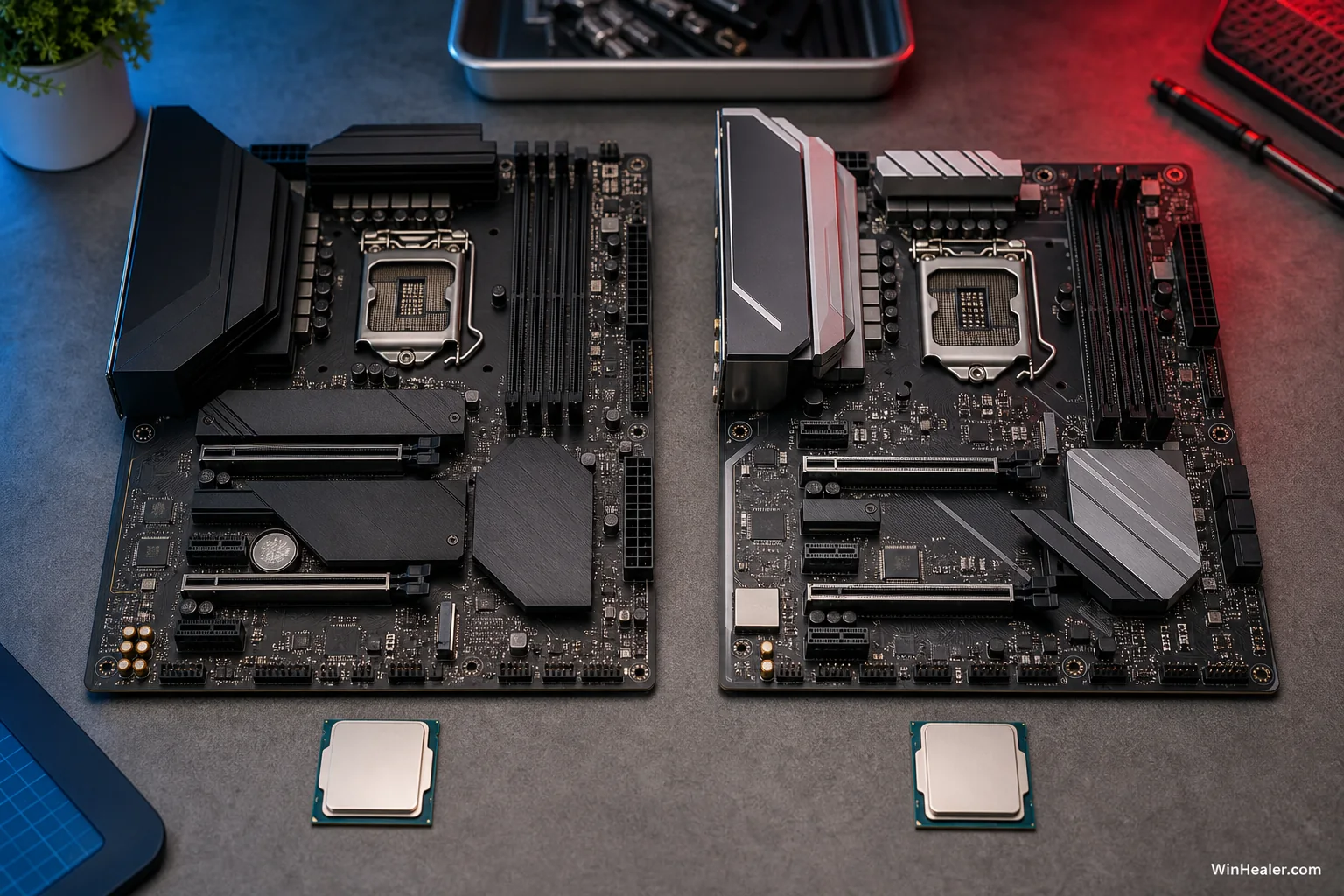
Both require DDR5. The 9800X3D supports A620, B650/B650E, X670/X670E, B840, B850, X870 and X870E boards; older boards may need a BIOS update. AMD extended AM5 support through 2029, the clearer long-term commitment here.
The 265K needs an LGA1851 800-series board. Intel’s 2026 Core Ultra 7 270K Plus remains compatible with existing 800-series boards, confirming one upgrade generation, but Intel has not made AMD’s through-2029 promise.
Both now have newer relatives: Ryzen 7 9850X3D and Core Ultra 7 270K Plus. Older models may still be excellent discounted buys, so compare current prices rather than launch figures.
Platform cost can change the verdict. An existing AM5 owner may need only a supported BIOS and cooler for the 9800X3D, while moving to the 265K requires an LGA1851 board. A new builder should compare motherboard features—not just chipset names—including M.2 lane sharing, USB, networking and BIOS support. Buying unused expansion features is rarely better than putting that money toward the GPU, memory or storage that affects your daily work.
Cooling and power planning
AMD includes no cooler and recommends liquid cooling for optimal 9800X3D performance. Intel’s 250W maximum turbo power also calls for strong cooling and sensible motherboard limits. Air cooling may suit some builds, but airflow, ambient temperature and noise goals matter.
Avoid automatic “unlimited” power profiles you do not understand. AMD warns that operating outside specification can affect warranty coverage. Update BIOS and chipset drivers, test stability, and judge sustained clocks and noise—not one peak number.
Which CPU should you buy?
- Primarily gaming: Ryzen 7 9800X3D and its cache-heavy design.
- Rendering, compiling and mixed production: Core Ultra 7 265K, after checking your applications.
- Quick Sync video work: Core Ultra 7 265K, if your editor supports it.
- Gaming plus ordinary daily work: Ryzen 7 9800X3D; eight cores and 16 threads remain capable.
- Future CPU upgrades: AM5 has the stronger published commitment through 2029.
- Buying in 2026: compare discounts with the newer 9850X3D and 270K Plus.
For a high-end gaming build, I would choose the 9800X3D. For sustained multi-core and media work, I would shortlist the 265K and validate it in the exact software that matters.
Frequently asked questions
Is the Ryzen 7 9800X3D good for productivity?
Yes. It is an eight-core, 16-thread Zen 5 CPU. Its value is strongest for gaming; constant rendering or compilation favors comparing higher-core options.
Is 20 cores on the Core Ultra 7 265K the same as 20 Ryzen cores?
No. Intel combines eight Performance-cores and 12 Efficient-cores with 20 total threads. Cross-architecture core counts are not one-for-one performance units.
Can I reuse DDR4 memory with either CPU?
No. Both use DDR5. Verify the board’s memory support list, especially for high capacities or overclocked profiles.
Which processor is easier to upgrade later?
AMD promises AM5 support through 2029. Intel confirms 2026 Core Ultra 200S Plus support on existing 800-series boards, but that is not the same long-term commitment.
Official primary sources
- AMD Ryzen 7 9800X3D specifications
- AMD Ryzen 7 9800X3D launch announcement, claims and launch pricing
- AMD AM5 support through 2029 announcement
- AMD Ryzen 7 9850X3D announcement
- Intel Core Ultra 7 265K specifications and recommended customer price
- Intel Core Ultra 200S launch and platform information
- Intel Core Ultra 200S Plus compatibility announcement